
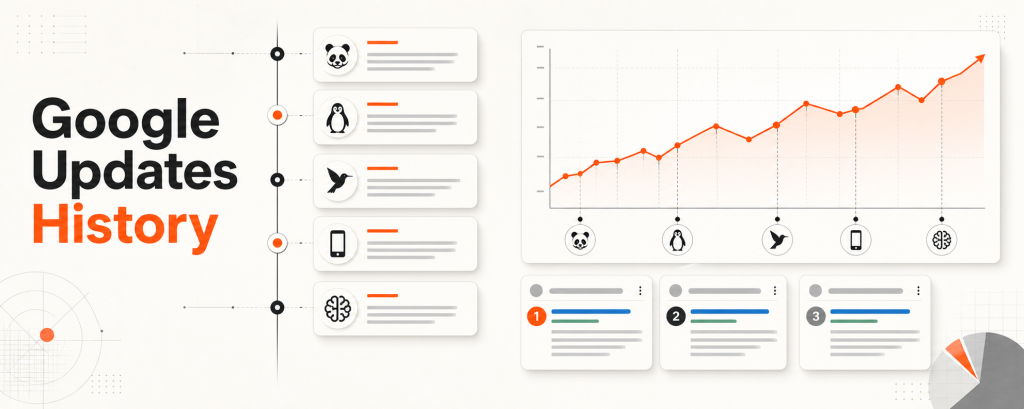
Google Search has changed from the old link and keyword system into a more usable, quality content, and intent discovery algorithm.
This timeline outlines all of the major updates Google has released since 2003.
Last updated: May 28, 2026. Google now maintains a public Search Status Dashboard for ranking updates, an official page of recent core, spam, reviews, helpful content, and page experience updates.
2003: Florida Update
The Florida update is from a time where old-school keyword stuffing and aggressive affiliate tactics were everywhere. This update pushed SEO away from mechanical repetition to finding content that provided real intent.
- Search Engine Journal: Google Algorithm Updates History – A timeline that places Florida among one of the earliest disruptive updates.
- Search Engine Land: Google Algorithm Updates – An industry-maintained archive of all major Google algorithm updates.
2011: Panda
Panda was released to target low-quality, thin, duplicated, or ad-heavy content. For business sites, the update was clear: pages need to be useful if they want to rank, not just target a keyword.
- Google Webmaster Central: High-quality sites algorithm launched in additional languages – Google described Panda as a quality improvement update that eventually expanded beyond the original rollout.
- Search Engine Journal: Google Panda Update – Explains how Panda changed expectations on content-quality for publishers and businesses.
- Semrush: Google Algorithm Updates Timeline – Summarized Panda as an aggressive move against unoriginal and unhelpful content.
2012: Penguin
Penguin focused on manipulative link patterns and webspam. It looked at backlink quality, relevance, and earned authority over volume alone.
- Google Search Central: Penguin is now part of our core algorithm – Google confirmed Penguin began in 2012 and later became integrated into the core ranking systems.
- Search Engine Journal: Google Penguin Update – Breaks down Penguin’s effect on link-building and spam tactics.
- Ahrefs: Google Algorithm Updates History – Provides a brief timeline of Penguin and future ranking-updates.
2013: Hummingbird
Hummingbird focused on understanding meaning, context, and conversational queries. This is one of the reasons why modern SEO works better when pages answer topics naturally, rather than repeating exact-match phrases.
- Search Engine Journal: Google Hummingbird Update – Explains how the update interpreted natural-language and intent interpretation.
- TechCrunch: Google made a shift to Hummingbird – Contemporary coverage of Google’s public announcement.
- Wikipedia: Google Hummingbird – Covers dates, naming, and general context.
2014: HTTPS as a Ranking Signal
Google made HTTPS a lightweight ranking signal and pushed the web toward securing their websites with SSL certificates
- Google Search Central: HTTPS as a ranking signal – Google’s official announcement that HTTPS is now part of ranking.
- Search Engine Watch: HTTPS ranking study – Analysis showed HTTPS was important but not a magic ranking lever.
- Google Search Central: Site moves with URL changes – A guide on how to move from HTTP to HTTPS or during a domain change.
2015: Mobile-Friendly Update
The mobile-friendly update rewarded website pages that were mobile friendly. It pushed the quality of responsive design, readable text, tap friendly pages, and mobile usability.
- Google Search Blog: Ranking change for mobile-friendly sites – Google’s rollout announcement of mobile-friendly ranking changes.
- Google Search Central: Rolling out the mobile-friendly update – Official guidance for site owners that were preparing for the change.
- Search Engine Land: Mobile-friendly rollout coverage – Industry reports on timing and impact of the rollout.
2018: Mobile-First Indexing and Speed Update
Google moved toward using mobile pages as the primary focus for indexing and put mobile page speed at the top of ranking discussions. The key takeaway was that technical SEO and UX now have a considerable overlap.
- Google Search Central: Rolling out mobile-first indexing – Google explained the shift from desktop-first crawling and indexing assumptions.
- Google Search Central: Using page speed in mobile search ranking – Official announcement of the mobile Speed Update.
- TechCrunch: Google page speed ranking coverage – Coverage of what the speed change meant for website admins.
2019: BERT
BERT helped Googles algorithm understand wording and query context more accurately. It reinforced the idea that pages should answer real question, not just match the most obvious keywords.
- Google Blog: Understanding searches better than ever before – Google’s announcement of BERT in Search.
- Search Engine Journal: Google BERT Update – Explains why BERT was important for natural-language search.
- Wikipedia: BERT language model – Information on the language model behind the update.
2021: Product Reviews and Page Experience
Google pushed harder on promoting websites with original reviews and page experience signals. Even service businesses can benefit from this: show first-hand expertise, reduce friction, and make pages easier to use.
- Google Search Central: April 2021 product reviews update – Official announcement that rewarded deep and more helpful and useful review content.
- Google Search Central: Timing for page experience – Google’s timeline and explanation of page experience ranking signals.
- Google Search Status Dashboard – Lists the June 2021 page experience rollout and related ranking-update history.
2022: Helpful Content Update
The helpful content update targeted content created primarily to attract search traffic instead of users. For a business website, this is an argument for getting rid of weak content, consolidating duplicates, and writing with real expertise.
- Google Search Central: Helpful content update – Google’s announcement and guidance for people-first content.
- Google Search Central: Guide to Google Search ranking systems – Explains how helpful content became part of broader ranking systems.
- Semrush: Google Algorithm Updates Timeline – How helpful content works with other Google updates.
2023: Reviews System and Update Transparency
Google continued moving individual updates into broader systems and consistent use of the Search Status Dashboard. This made monitoring updates and traffic changes easier for site owners.
- Google Search Central: Q&A on Search updates – Google’s explanation of how it communicates updates and how multiple rollouts can overlap.
- Google Search Status Dashboard – Shows 2023 reviews, spam, helpful content, and core updates.
- Search Engine Journal: Google Algorithm Updates History – Industry overview for review related updates and other major 2023 changes.
2024: March Core Update and New Spam Policies
The March 2024 update was very large and it was tied to a more clear spam policy around scaled content abuse, expired domain abuse, and site reputation abuse. It also integrated more helpfulness evaluation into core ranking systems.
- Google Search Central: March 2024 core update and spam policies – Official guidance for creators and site owners.
- Google Blog: New updates to address spam and low-quality results – Google’s broader public announcement related to the quality and spam changes.
- Search Engine Journal: March spam update completed – Industry reporting of the rollout progress and policy impact.
2025: AI Search Guidance and Core Updates
Google’s AI search guidance pushed for the same fundamentals: original, useful content, clear page experience, crawlable pages, and structured signals that help systems understand websites. History also shows multiple 2025 core and spam rollouts.
- Google Search Central: Top ways to perform in Google’s AI experiences – Google’s guidance for staying visible as Search integrates AI.
- Google Search Central: Creating helpful, reliable, people-first content – The core content-quality guidance that is applied across classic and AI search mediums.
- Google Search Status Dashboard – Cites March 2025, June 2025, August 2025, and December 2025 algorithm ranking updates.
2026: Core, Spam, Discover, and AI-Era Monitoring
As of May 28, 2026, Google’s ranking dashboard cites a February Discover update, March 2026 spam update, March 2026 core update, and May 2026 core update. For site owners, the logical move is to pair content quality work with Search Console monitoring during and after every confirmed rollout.
- Google Search Status Dashboard: Ranking history – An official source for current and recent ranking incidents, including 2026 updates.
- Search Engine Land: March 2026 core update completed – Industry coverage of the March 2026 core rollouts timing.
- Search Engine Journal: Google confirms March 2026 core update complete – Additional reporting on the Search Status Dashboard.
What This Means for SEO Today
The pattern has been consistent: Google is getting better at pushing down websites that take shortcuts and rewarding websites with useful pages that people will trust. The safest long-term SEO strategy is to publish content with original expertise, has a clean technical foundation, keeps duplicate content under control, earns relevant links.
In 2026 it is the norm to monitor confirmed ranking updates rather than reacting to daily fluctuations.

